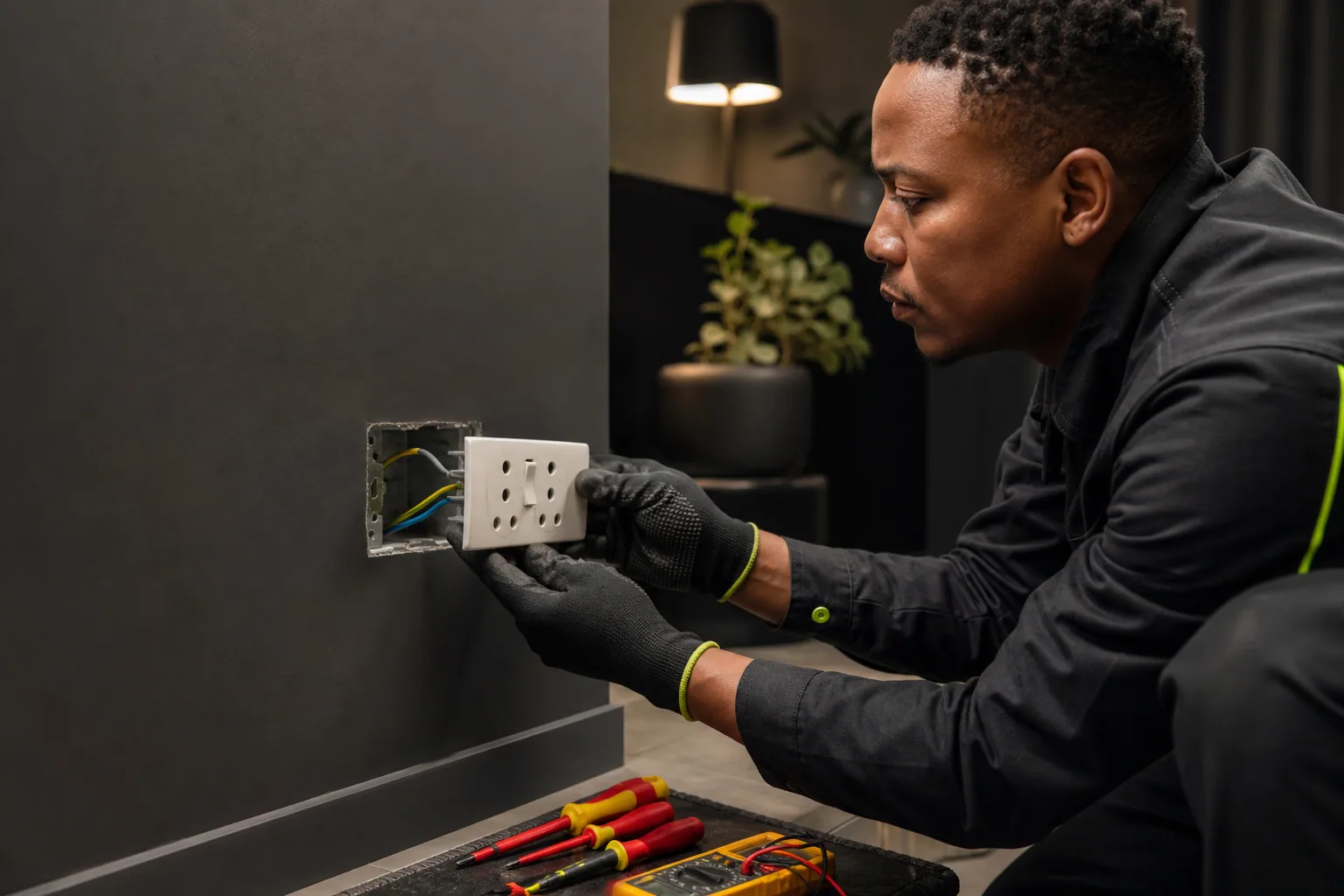
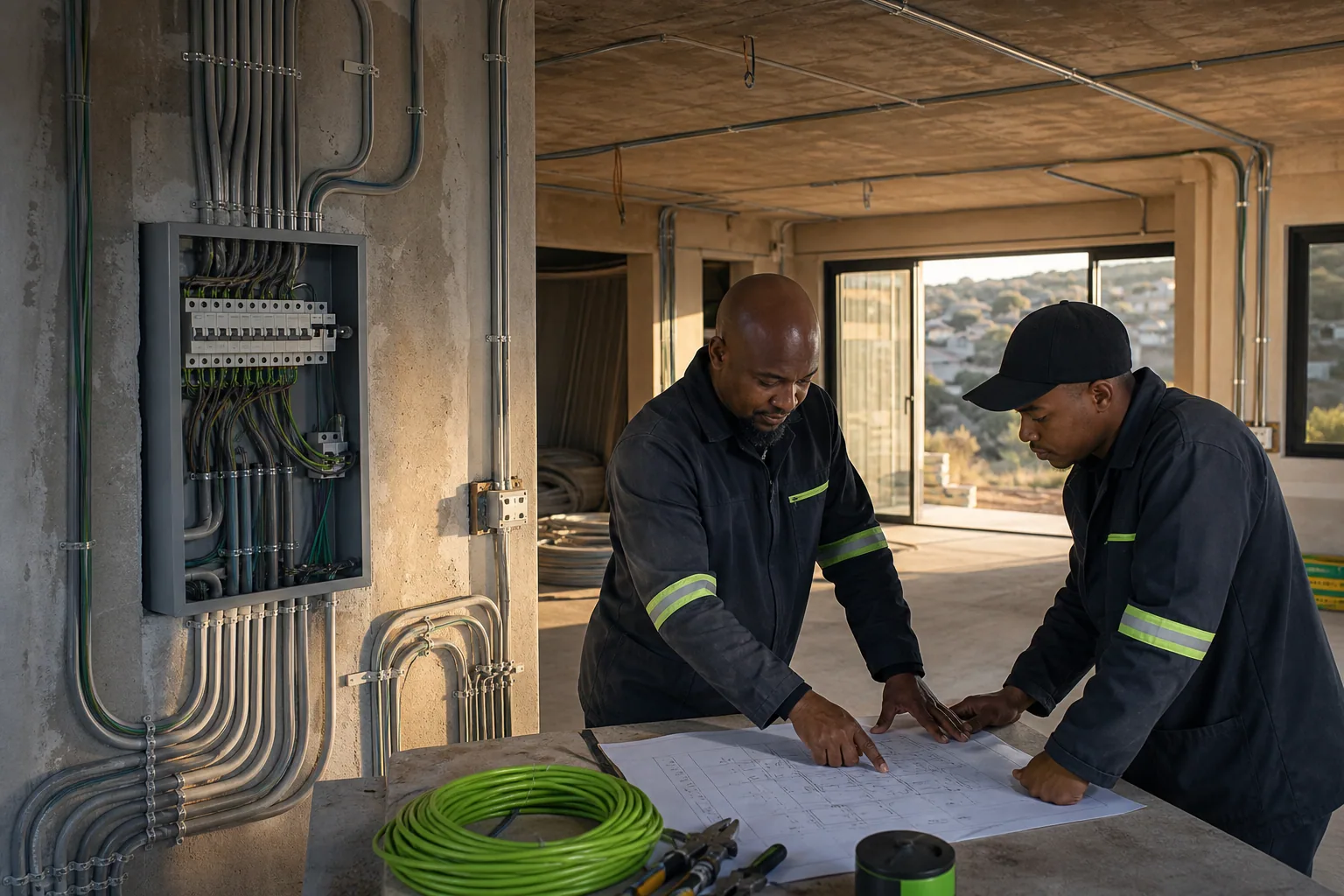
There is no responsible single price for wiring every four-bedroom house. A compact new build with open walls, a standard specification and 30 points is a different project from rewiring an occupied face-brick home with two distribution boards, an electric fence, pool, borehole, inverter and premium fittings.
The best way to budget is to count the required points and dedicated circuits room by room, then add the distribution board, main supply work, testing, certification and building work. Published 2026 guidance uses indicative rates around R1,050 per point for a standard specification and around R1,400 per point for premium fittings, but the definition of a point and the inclusions must be confirmed.
01
New wiring and rewiring are not the same job
New-build wiring is normally installed before ceilings and wall finishes close, so routes are accessible. A rewire requires investigation, isolation of old circuits, access through ceilings or floors and sometimes wall chasing and repair. Furniture, security systems and occupied rooms also slow the work.
Ask the electrician to state whether the quote includes removal or safe abandonment of old wiring, temporary power, chasing, patching, testing and a COC. A rewire quote that excludes making good can look cheaper while leaving significant building costs behind.
| Project | Usually easier | Usually adds cost |
|---|---|---|
| New build | Open routes and coordinated trades | Design changes, premium fittings, long runs |
| Full rewire | Empty property with good ceiling access | Occupied rooms, solid walls, old conduits, repairs |
| Partial upgrade | Clearly isolated circuits | Unknown alterations and mixed old/new wiring |
02
Build the scope room by room
Walk through the plan and count every socket, light, switch and dedicated supply. Agree exactly what the word point means. Some quotes count a two-way switching arrangement, data outlet or long exterior run differently.
A four-bedroom scope commonly includes more than the bedrooms: kitchen appliances, bathrooms, passage, lounge, dining room, garage, exterior lights, gate, alarm, pool, borehole and backup-power connections.
- General socket outlets and USB or smart outlets
- Interior, exterior and security lighting points
- Stove, oven, geyser, pool pump and borehole circuits
- Garage, gate motor, intercom and electric-fence supplies
- Distribution board, surge protection and earth-leakage protection
- Inverter, solar, generator or future-ready provisions
- Testing, circuit labels, as-built information and certification
03
A practical budgeting model
Multiply the agreed number of ordinary points by an agreed installed point allowance. Then price dedicated circuits separately because cable size, isolation and protection differ. Add the distribution board and protective devices, main cable or meter work, specialist systems, testing and certification, building repairs and a contingency.
If a standard 30-point project is modelled at the published R1,050-per-point guide, the point subtotal is R31,500. That is not the finished project price: dedicated appliances, DB work, long cable runs, premium fixtures, access and VAT may sit outside it. Use the calculation to test a quote, not to replace one.
04
What changes the price most?
The biggest price changes usually come from access and specification. Concealed wiring in finished walls takes longer than surface work in an open garage. A basic white socket is different from a premium, weatherproof or smart device. Long cable runs and large loads need more copper and different protection.
- Floor area and distance from the distribution board
- Number of points, circuits and switching arrangements
- Brick, concrete, face-brick, tiled or lightweight walls
- Ceiling height, roof space and occupied-property access
- Condition and capacity of the existing distribution board
- Earthing, bonding and surge-protection requirements
- Solar, inverter, generator, pool, gate or three-phase equipment
05
The quote checklist that protects your budget
Give every contractor the same marked-up plan or room schedule. Ask them to price the same fixtures and state allowances. The quote should explain who supplies fittings, what testing is included, how variations are approved and when payment is due.
Before choosing a price, ask how the completed installation will be tested and certified. Saving on the testing stage is not a saving if the installation cannot be safely energised or transferred later.
- Point schedule and dedicated-circuit schedule attached
- Fitting brands or realistic allowances stated
- DB, earthing, surge protection and labelling included or excluded
- Chasing, patching, painting and waste removal allocated
- Variation rates and written approval process agreed
- Testing, test report and applicable COC clearly included
FAQ
Questions readers also ask
What is the average cost to wire a four-bedroom house?
Bedroom count alone is not enough to produce a reliable average. Count ordinary points, dedicated circuits and DB work, then include access, finishes, testing, certification and VAT. A site-specific written quote is essential.
Is rewiring more expensive than wiring a new house?
Often yes, because an existing house can require investigation, removal or isolation of old wiring, restricted access, wall chasing and making good. An empty property with accessible ceilings can reduce the difference.
How many electrical points does a four-bedroom home need?
There is no universal number. It depends on the room layout, appliances, lifestyle, security, exterior areas and future plans. A room-by-room schedule prevents forgotten points and expensive later additions.
Does a house-wiring quote include a COC?
Do not assume it does. Ask the contractor to state whether inspection, testing, the test report and the applicable Certificate of Compliance are included.